
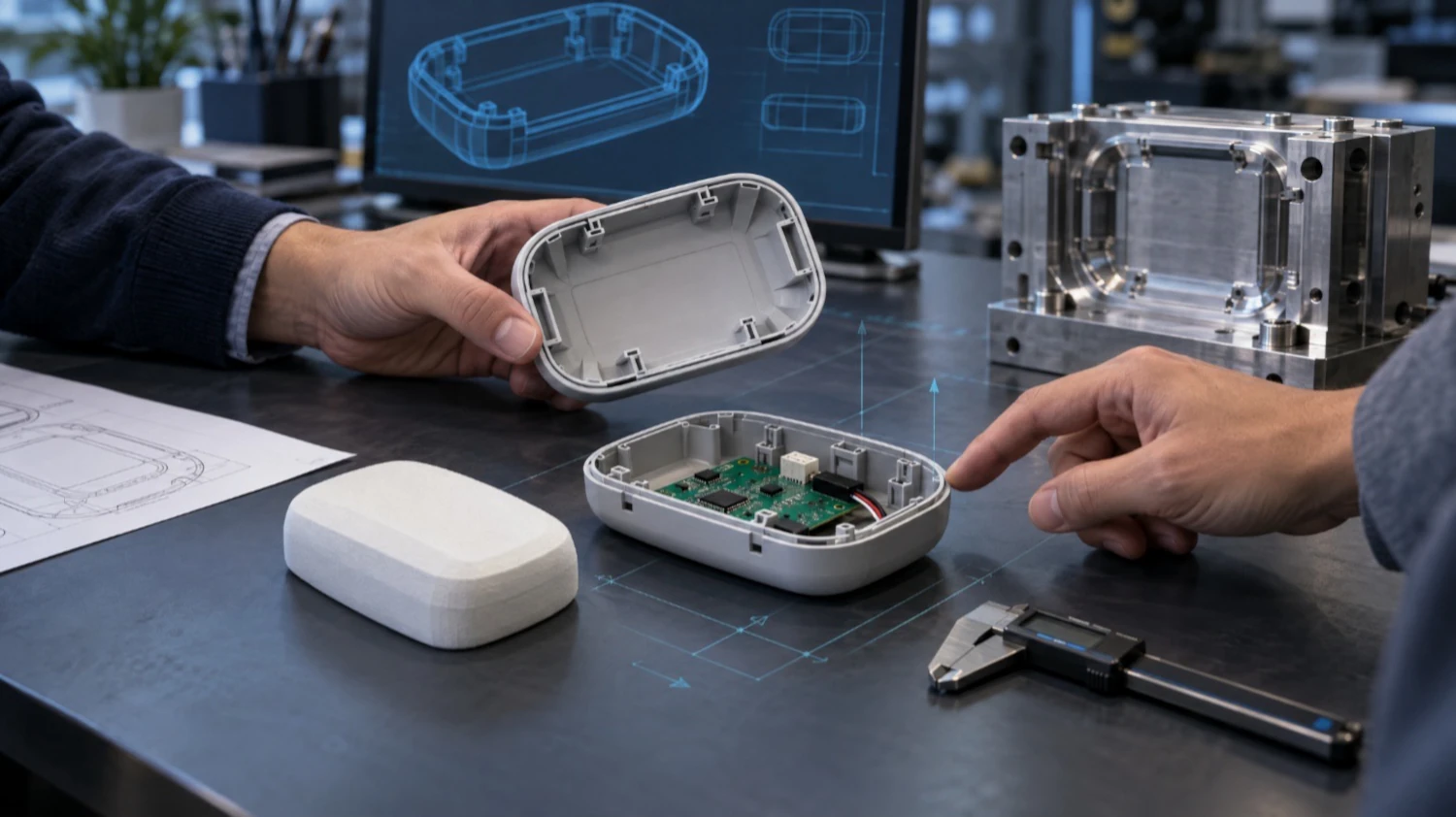
Design for Manufacturing Is the First Step, Not the Final Step

Brad Carlson explains how involving manufacturing early in product development helps teams make better decisions about tooling, tolerances, and assembly, with lessons from the NeuStim™ wearable.
Design for Manufacturing Is the First Step, Not the Final Step
If you have brought hardware from concept to production, then you have likely been in the meeting where ID is signed off, the prototypes power up, CAD looks finished and the model comes back from DFM review by suppliers covered in redlines.
Some common examples of misses: no draft on some faces; walls that go from thin to thick on the same part; a snap fit that needs a side action nobody quoted; a cosmetic gap that wanders across four parts in a stack; or an assembly step that requires three hands.
None of that is unusual, and all of it can be fixed. The problem is getting surprised by it late in development. If manufacturing shows up for the first time at the end, you’re not designing for manufacturing - you’re asking the factory to forgive the design.
By the time a model is “done,” a lot of the cost and risk is already baked in. I’d rather have the constraints in week two than in week twenty. Three places where it matters most:
Tooling
Every manufacturing process has rules: molded parts need draft; uniform walls keep you out of trouble with sink and warp; undercuts mean side actions or lifters, which add cost to the tool and time to the cycle; and the parting line is going to show up somewhere whether you chose the location or not.
When those rules get applied to a finished model, things start colliding. Add draft and a boss interferes with a rib. Thin the rib to get rid of a sink mark and now the part doesn’t survive drop test. Try to find a clean split line on a housing that was never laid out around a pull direction, and you end up with a compromise nobody loves.
What works better is boring and early. Pick the pull direction and parting line in the skeleton model so every downstream activity inherits them. Drive wall thickness and draft with parameters, because the material will probably change at least once. Get ID and mechanical to agree on where gates, ejector marks and knit lines are allowed to live. Call the toolmaker before the design freezes – it’s an inexpensive call, but reworking a tool is not.
Tolerances
Every part varies – the question is whether your design tolerates it or not.
If the first tolerance stack happens after detailing, the only lever left is usually tighter tolerances, which means more expensive parts and unhappy suppliers. Run the stack while the architecture is still loose and it tells you something more useful: where the design itself should change.
Sometimes that means fewer parts between two interfaces that matter, like mounting a critical component straight off the chassis instead of through two brackets and a sub-frame. Sometimes it means choosing datums the process can actually hold and making sure the assembly fixtures use the same ones as the design. Sometimes it means designing in a little give with crush ribs, floating mounts or a gasket. And sometimes it just means admitting that most dimensions don’t matter that much therefore spending your precision on the few that do matter.
In medical devices, defense hardware and wearables, those few usually involve sealing, alignment or something the user touches. None of those are easy to fix once you’re in production.
Assembly
Assembly cost accumulates slowly: one more screw; one more step flipping the unit over; one more cable someone must route by hand. Each one adds time and gives somebody another reason to get it wrong.
DFA is a well-known concept, and it only helps while the architecture can still move. Ask three questions about every part: (1) does it move relative to the parts around it? (2) does it need to be a different material? And (3) does it ever need to come apart? If the answer is no across the board, it probably wants to be merged with its neighbor.
Beyond that, build in one orientation if you can. Key the connectors and make asymmetric parts obviously asymmetric so they can’t go in backwards (poke-yoke). Lay out the harness and flex circuits with the mechanical design, not after it. Cable routing is the classic “we’ll figure it out later” item, and it’s three disciplines’ problem at once. And think about the technician who may need to troubleshoot and repair the product.
A real example: NeuStim™
We saw this on NeuStim™ with our client Neuvotion. NeuStim is a non-invasive wearable that stimulates muscles to help people recover hand movement after a stroke or spinal cord injury. Neuvotion announced its FDA 510(k) clearance in February 2025.
Our scope covered hardware, firmware and software, including industrial design, material selection and manufacturing process development. We also helped Neuvotion choose contract manufacturers and assisted with production transfer. Our mechanical, ID, electrical, embedded systems and software engineers worked through those questions together with the rest of the design instead of saving them for the end.
A device like this makes the case on its own. It’s worn on a patient’s arm. Different patients use it across different clinic visits. Clinicians need to set it up quickly. The geometry, the materials and how the thing gets built are all tied together, and if you change one late in development, the other two move with it.
Who owns DFM?
There is no single owner of DFM. ID owns the surfaces people see. Mechanical owns the structure. Electrical and firmware own what must fit, function and connect. Your manufacturing partner knows what their process is capable of. Get them in the same room at the first concept review, not the last design review.
That doesn’t make the design timid. It makes the bold version buildable, so what ships still has the look that got approved.
Bottom line
An end-of-design DFM review is still worth doing. It just shouldn’t be the first time anyone asks how a part gets molded, how the tolerances stack up or how someone on the line puts it together. Ask those questions early and you’ll see fewer late redlines, fewer tool changes and a better shot at your launch date.
How early does manufacturing get a seat at the table on your programs? I’m curious about what has worked for people, and what hasn’t.
#DFM #ProductDevelopment #MedTech #Manufacturing #IndustrialDesign


