Cross-Pollinating Tech: What Consumer Electronics Can Teach Defense Hardware

The fastest-moving lab for compact, intuitive hardware isn't a defense prime. It's the consumer electronics industry, where products ship in the millions and miss a single year's cycle at their peril.
Defense and industrial programs have long treated consumer tech as a different world: too fragile, too short-lived, too insecure. Those concerns are real. But the gap has become a liability. A soldier carries a smartphone that is smaller, faster, and easier to use than much of the gear issued to them, and the same is true of a technician on a plant floor.
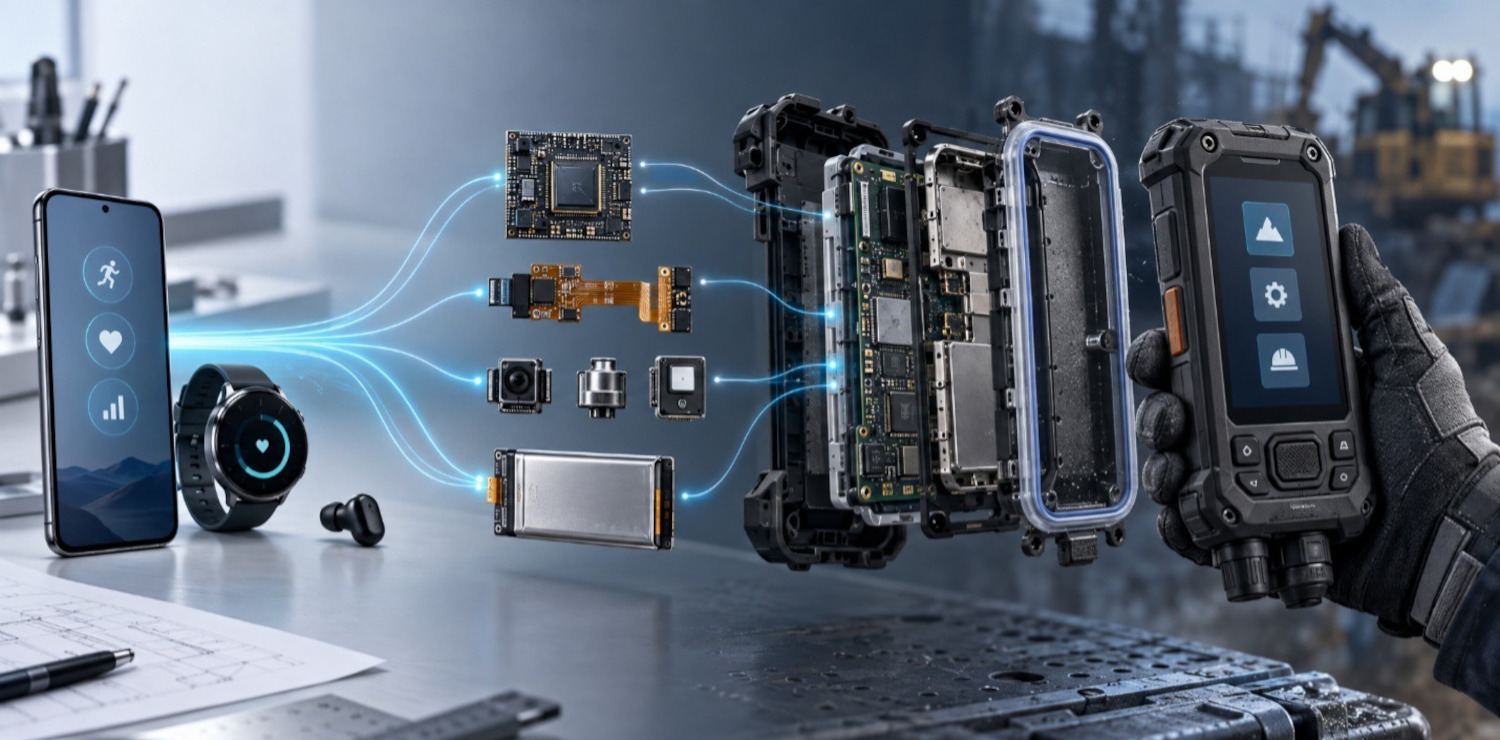
At IPS (Intelligent Product Solutions), we design across both worlds, from wearables and connected consumer products to rugged systems for defense and industrial clients. The lesson we keep relearning: the best mission-critical hardware borrows aggressively from consumer engineering, then hardens what it borrows.
Lesson 1: Miniaturization is a supply chain skill, not just a design skill
Consumer volume has funded a decade of size, weight, and power (SWaP) gains that defense programs could never pay for alone. Those gains are now sitting on distributor shelves, ready to use.
- System-on-chip and system-in-package integration. Processors, radios, power management, and memory now ship in single packages built for phones and wearables. A circuit board that once needed a dozen ICs can shrink to a handful.
- Power efficiency. Battery-driven consumer products forced aggressive low-power design: dynamic voltage scaling, deep sleep states, and efficient wireless protocols. For a dismounted operator, every milliwatt saved is weight they don't carry in spare batteries.
- Dense interconnect and packaging. High-density interconnect (HDI) boards, rigid-flex assemblies, and fine-pitch components let electronics fold into irregular enclosures, the same way they fit inside an earbud or a smartwatch.
- Sensor fusion at scale. Low-cost inertial sensors, cameras, and environmental sensors, paired with mature fusion algorithms, make capabilities like navigation aiding and condition monitoring affordable to add.
The takeaway for program leads: start a SWaP-constrained design by asking what the consumer ecosystem already solved, not by specifying a custom part from scratch
Lesson 2: The best interface is the one nobody has to be trained on
Consumer products succeed or fail in the first few minutes of use, with no manual and no instructor. That pressure produces human interface patterns that mission-critical systems can borrow directly.
- Familiar mental models. Operators already know swipe, pinch, and tap. An interface that follows those conventions cuts training time and reduces errors under stress.
- Progressive disclosure. Phones show the essentials first and tuck advanced settings a layer down. A field system can do the same: the three actions that matter most on the main screen, diagnostics one level deeper.
- Glanceable information. Smartwatches taught designers to deliver status in under two seconds through color, icons, and haptics. That is exactly what someone needs when their eyes and hands are busy.
- Multimodal input. Voice, haptics, and physical controls let users act without looking down. In gloves, rain, or low light, these become essential, not optional.
- Continuous iteration. Consumer teams test with real users early and often. Defense programs that run usability sessions with operators, rather than only reviewing requirements documents, catch problems while they are still cheap to fix.
Good UI is not cosmetic in a mission-critical setting. It isa direct contributor to safety, speed, and readiness.
What doesn't carry over, and how to bridge it
Borrowing from consumer electronics works only when engineers are clear about where the two worlds diverge. The gaps are predictable, and each has a known engineering response.
The goal is not to drop a consumer module into a rugged box. It is to adopt the architecture and design patterns, then engineer the hardening around them.
A practical framework for cross-pollination
Teams that do this well follow a consistent sequence. Here is the approach we use with defense and industrial clients.
- Scan the consumer ecosystem first. Before writing a custom requirement, survey what high-volume products already do: the chipsets, sensors, interaction patterns, and power architectures.
- Separate the pattern from the part. Decide whether you are borrowing a component, an architecture, or a design idea. Patterns transfer easily; specific consumer parts may not survive a 15-year lifecycle.
- Prototype fast, then harden. Build early proofs of concept with commercial parts to validate the user experience and the SWaP budget. Ruggedize once the concept is proven.
- Put operators in the loop early. Run usability sessions in realistic conditions: gloves on, lights off, noise up. Feedback at this stage costs a fraction of a fielded fix.
- Design for sustainment from the start. Plan obsolescence management, second sources, and modular upgrades so the system can absorb the next round of consumer advances.
- Test to the real environment. Validate against the applicable MIL-STD or industrial standards before production, not after.
The edge goes to teams that work both sides
Consumer electronics and defense hardware are converging. The organizations that win will be the ones fluent in both: fast and user-focused like a consumer team, rigorous and durable like a defense supplier.
That combination is how IPS works. Our engineers move between wearables, consumer devices, medical products, and rugged defense systems, carrying lessons in both directions. If your next program needs to be smaller, lighter, and easier to use without giving up reliability, let's talk.
.avif)